
By Isaac Ato MENSAH
Accra- 29 September, 2018.
The question in the title of this story gets an A from us.
You can never tire of asking what the problem is with our Ghanaian leadership.
Many of them are highly schooled.
We respect that.
But alas, need we repeat that there are differences between schooling, training and education?
The question which forms the basis of this story, is about Nigerian traders, in particular, being driven out of the retail trade business in Ghana.
Ken Ukaoha, one of the speakers at a demonstration at the Ghana High Commission in Abuja and the ECOWAS Secretariat in Asokoro, both in Nigeria, asked that question which embarrasses all Ghanaians and rightly so.
Ukoaha led a demonstration by National Association of Nigerian Traders with a very appropriate and powerful message not only to Ghanaians and Nigerians, but to the whole world.
His language, intonation, inflexion and style are very appropriate to the audience and helps to drive home his message with clarity; his logic unassailable; his rhetoric too totally convincing.
The problem the speaker presents is the same old thematic drive of this blog, namely, doing the right thing and admitting the truth.
But why is the Ghanaian political leadership consistently failing to do the right thing?
It is our considered observation that either they are ignorant or they are dishonest.
Could our oral culture be blamed for our lack of adherence to simple agreements and principles?
Sir Jack Goody, an anthropologist established ‘links between very
different civilisations and the processes of change.
One of his most remarkable pieces of work was a comparison between the societies of ancient
Greece and modern Ghana’, reported www.theguardian.com in 2015.
Goody concluded that in oral cultures there is “structural amnesia”, the loss of the memory of
differences between the past and the present.
‘In these cultures the memory of changes is lost in a generation or so, since the past is constantly
updated, by being reconstructed in the image of the present’, Peter Burke and Joe McDermott, the writers of Goody’s obituary in The Guardian, continued.
What Goody infers is exactly what we see in Ghana.
That is, public policy and decisions based on an ad hoc approach devoid of rational analysis and often predicated on narrow parochial interests.
Important decisions are not reached after serious and objective historical inquiry, comparison and scepticism.
Such an ethos in our community will allow knowledge to accumulate, undermining structural amnesia thus leading to an expansion of the intellectual horizons of the community.
In short it will promote rational and progressive planning and avoid the protean retrogressive acts and decisions that emanate from our political leaders.
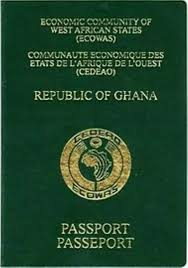
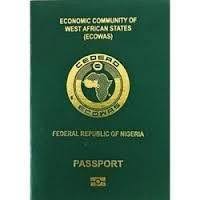
In the videos, circulating on social media, Ukoaha asks, ‘Why did Ghana sign the Ecowas Protocol…on free movement of goods, free movement of persons…free movement of services….are Nigerians in Ghana foreigners?’
Then there appears a placard held by a lady with the inscription, ‘IS THIS ANOTHER GHANA MUST GO?’
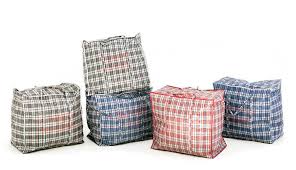
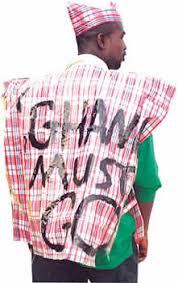
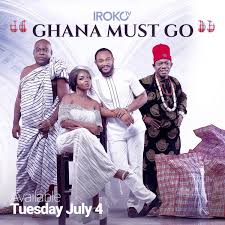
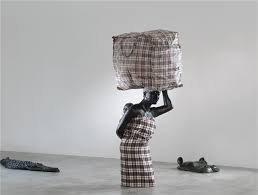
That inscription references the painful period of the late 1970s and early 80s when Ghanaians sojourning in Nigeria due to the failure of our political administration, both military and civilian, were driven home, with some carrying “Ghana Must Go” bags.
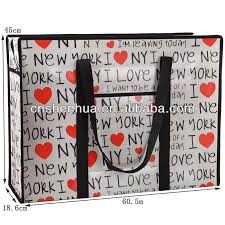

I remember someone who came home with a telephone handset.
We the children every now and then asked him the relevance of the telephone because it was not connected; it was just sitting on the table.
Even as children we knew that whatever reason he offered for returning home with only a telephone handset, was totally unconvincing.
Ditto for the current Ghanaian government harassment of Nigerian traders in Ghana.
Are we not capable of learning the right lessons from our recent history?
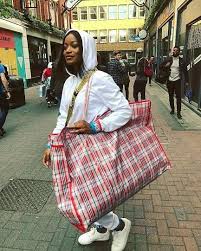

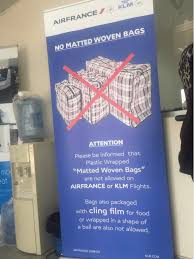
Can we learn anything useful from how other people have transformed the “Ghana Must Go” bag?


Feedback: [email protected].
Writers and Shakespeares Ghana Limited exists to be a moral and intellectual guide the best practice of PR and integrated communications around the world, beginning with Ghana.
Comments are closed, but trackbacks and pingbacks are open.