
By Isaac Ato MENSAH
Accra – 18 January, 2019
A journalist can never be idle; there will always be some work to do, some story to cover.
‘Everybody wants a job, but no one says there is no work to do,’ is another unforgettable one from my mentor.
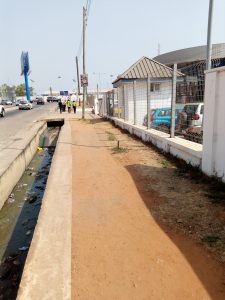
So whilst hanging out – perched at quite a height at the posh Airport City Accra, I was drawn to billowing and beckoning smoke from behind some walls.
‘These must be chop bars I surmised,’ of course I know my city so well.
Local restaurants aka chop bars often burn firewood on three-legged clay stoves from behind the eateries.
‘Where do you get food to eat,’ I asked a security guard who was having lunch.
‘From the Police Barracks or from Aviance,’ came the reply.
We then quietly discussed the details of the eating habits of the “mmobrowa” or proletariat working within the airport area.
He urged me to visit the places.
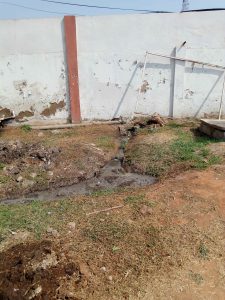
I went to Aviance, the Cargo Village, so called.
‘Could you please direct me to the chop bar,’ I asked the security man at the gate.
‘Just behind me,’ he motioned to the left.
And there it was; the usual dirty dusty brown earth of the city you know already.
Everything was in place.
The chop bar I entered had banku ready, except that this time it was not wrapped in plastic bags; it was wokple, our Ewe compatriots’ variant of cassava starch mixed with corn dough.
And then there were rice balls, wrapped in plastic bags.
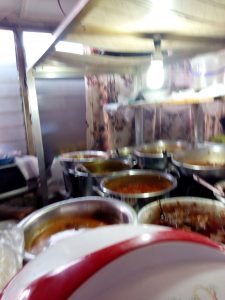
All the usual soups with assorted meat and fish were available – okra, palm nut, peanut and light soups.
The restaurant was about the size of a 40-foot container, and it was hot inside despite three ceiling fans rotating noisily at the highest speed.
‘Expensive ladies park their cars and eat here,’ an elderly man informed me. ‘All the bank ladies park their cars here early in the morning for heavy breakfast.’
The food here is admittedly cheap; with three Cedis (60 US Cents) one can have a heavy Ghanaian meal, that is, if you do not eat too much; a sachet of “pure water” is the usual 20 pesewas (4 US Cents).
‘Foreigners also come here,’ a septuagenarian who has worked here for 40 odd years told me. ‘White folk sometimes prefer it hot in here. They want to feel Ghana as it is.’
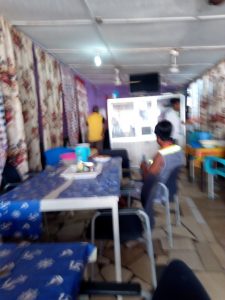
There were a few houseflies and as usual they were irritatingly busy – a nuisance.
The Aviance Cargo Village located about 100 meters southwest of the runway has about 11 chop bars or restaurants.
There is porridge made from oats or maize, noodles and Jollof rice (rice boiled in tomato sauce) available.
And then there is the favourite heavy meal delicacy of the proletariat – kokonte (blended dried cassava chips prepared into balls of starch or scooped with a ladle when needed).
‘The land was to be taken away for redevelopment but workers protested,’ my septuagenarian responded when I asked about the need to develop the place.
The other restaurants are expensive so the ordinary workers prefer to have their own standards.
For example a 750 ml bottle of water at Landing Restaurant is about five Cedis (USD 1.00).
Of course in such dry January weather, you will need to drink more.
If you are a foreigner not familiar with Ghana, you need to know that our tap water is not drinkable.
The alternative restaurants are not affordable even for the middle class.
For example, a plate of boiled rice with chicken at Landing restaurant is about 50 Cedis (US10) and of course you need a 1.5 litre bottle of water at 10 Cedis (US2).
The so called traditional Ghanaian hospitality where guests are welcomed with water does not apply in our restaurants; a waiter will never serve you water unless you ask.
Then (s)he will ask you the size of the bottle you want, which of course means the waiter is mindful of your budget.
The menu is not placed front of you, to choose at your pleasure.
Immediately you sit down, some poorly trained (or are they trained?) waiter comes to stand by your shoulder and insists on you making your choice from the menu without even asking you if you care for some water.
And usually virtually everything listed in the menu is not available.
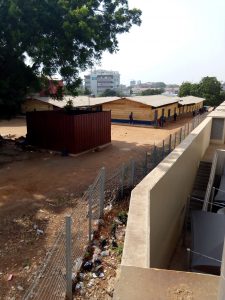
If this attitude of the political and business leadership continues – in their not wanting to address our dining culture – then our modern commercial hubs with their international architecture, will continue to billow and beckon with smoke from chop bars, patronised by office workers eating heavy meals with their fingers.
Why should you care?
This is our way!
If you do not like it then ……
Well, never mind.
My sister tells me at her base in the US, at the slightest sign of smoke you gotta call the emergency lines.
And this is our Accra Airport City a much touted example of “Accra’s changing skyline”.
Feedback; [email protected].
Writers and Shakespeares Ghana Limited exists to be a moral and intellectual guide to the best practice of PR and integrated communications around the world, beginning with Ghana.