By Isaac Ato MENSAH
Accra – 7 January, 2019
The United Nations International Year of Indigenous Languages (IYIL 2019) is here with us.
The international media has given tremendous publicity to the formal launch ceremony scheduled for January 28 in Paris, France.
The Vatican media, for example, has highlighted the event and accorded it editorial focus.
Religious institutions place much premium on language and culture to enhance their evangelisation missions.
But what is the stance of Ghanaian state institutions on the year-long affair?
Do our state institutions need to hype this occasion and tell us whether they are attending or not and if not why?
Do we not need to know their position papers ahead of time?
Two academics (Akpanglo-Nartey and Akpanglo-Nartey) writing in the American Journal of Linguistics (2012; Volume 1, Issue 2 stated: ‘….Ghanaian English (GhE) and Akan, especially the Twi dialect, and to a small degree, Ewe, are slowly killing off the smaller Ghanaian languages’.
They further observed that whereas ‘in 1970 almost all Winneba natives spoke Efutu (Ewutu) as their first language, by 2010, only approximately 50% of children born to the Winneba natives spoke Efutu as a first language, and about 30% of these children speak no Efutu at all’.
They also noted that medium-sized languages such as Ga, Dangme and Nzema are also slowly losing grounds to the three languages cited.
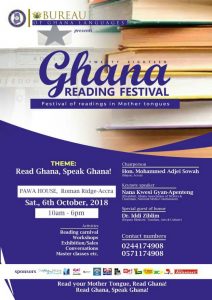
Out of at least 46 Ghanaian languages, only nine are written in school – and that is another matter.
Talensi for instance, is not written – it is spoken mainly in Upper East Region.
Syndicated radio broadcasts have exacerbated the phenomenon of dying languages in Ghana.
It is leading to certain languages monopolising our airwaves.
Where a language is not written, justice is served when it finds expression through the media.
Whatever happened to the initial useful injunction on a commercial radio station to install a maximum three-kiloWatt transmitter?
Was that policy not meant to develop the capacity and survival of regional and community radio stations and thus robustly promote our cultural diversity?
So why is this not being enforced?
When the GJA awards are all skewed towards the media in Accra, why is anybody surprised that the remaining nine regions do not have the capacity to compete?
Meanwhile the refrain of the National Communications Authority is that they are not responsible for media content; they are quick to pass the buck to the National Media Commission.
As for the National Media Commission, they, like most Ghanaian public institutions, will only become aware when the ‘national security threat’ card is waved in their faces.
The Year of Indigenous Languages is here with us.
Are we ready to embrace it and celebrate our differences as a means of preserving our cultural heritage?
In reality, the marginalization and demise of minority languages leads to destruction of intellectual and philosophical concepts and perspectives; it should be resisted in democratic and progressive societies by all enlightened people.
To all indigenous peoples of the world, we salute you for your resilience and wish you successful deliberations in France.
Feedback; [email protected].
Writers and Shakespeares Ghana Limited exists to be a moral and intellectual guide to the best practice of PR and integrated communications around the world, beginning with Ghana.