
By Isaac Ato MENSAH
Accra – 24 December, 2018.
The controversy over celebration of Christmas and the constitutional rights of citizens is an annual debate around the world.
It gets complicated when the affected groups have not openly complained or worse still they take active part in it.
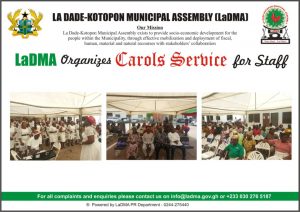
An announcement from the La Dadekotopon Municipal Assembly (LADMA) in Accra circulating on social media shows that to all intents and purposes, the state’s resources are being used to celebrate a festival of nine lessons and carols aka carol service.
LADMA is not the first to do this; over the years the parliament of Ghana, Ghana Broadcasting Corporation and other state agencies have also done this.
Perhaps when you once saw the Right Honourable Speaker or the Chief Justice stepping forward to read say, the fifth lesson or sixth lesson, you were so intimidated by their legal pedigree you did not dare ask any questions.
Or perhaps when you saw Members of Parliament of all religions take part in a carol service you thought it was cool.
But it is against the spirit and letter of the 1992 Constitution.
There is an entire chapter devoted to this subject; the directive principles of state policy (DPSP).
The DPSP is found in the laws of many relatively young democracies including India.
The idea behind it should not be too deep to fathom; national cohesion.
In summary the DPSP says that there shall be no discrimination based on gender, religion, ethnicity or on any other grounds.
But Ghana is a country that is strong on religious tolerance.
For example, many Christians openly demand their Eid mutton or beef from Muslims.
In Africa, Senegal is also notable for religious tolerance; Abdulai Wade, a non-Muslim, was elected several times to lead that country with a Muslim population of over 90 percent.
But when other sects and individuals have issues with Christmas, we should not discount it.
Information abounds from multiple reputable sources about how over 70 per cent of the world’s population will live in a Muslim majority nation in a few decades.
But we do not need to get there yet.
How will you feel, if a district assembly in Ghana staffed mostly by Muslims stops work five times a day to pray.
And then uses its resources to support Eid celebrations.
And then also uses its funds to support Hajj pilgrimage.
And then……and then it is all openly displayed and defended in the annual account?

And finally you are watching all these being discussed at a Public Accounts Committee sitting of parliament live on TV.
In South Africa, the “Organisation for Religions Education and Democracy” in English (OGOD) sued six state institutions for identifying themselves as and acting Christian, wrote Georgia Alida du Plessis in theconversation.com on 10 May, 2017.
The author argued, ‘But OGOD’s claim to be doing so under the auspices of secularism is not uncontroversial. That is because South Africa is not a strictly secular country. South Africa doesn’t have the similar strict separation between religion and the state as found in the United States, for example’.
In Ghana the Ghana Health Service and Teaching Hospitals Act (1996) provided for a rep of ‘the Christian group and the Muslim group’ in each district to be coopted into the District Health Management Team.
Apparently this was in recognition of the fact that many of our health facilities in the rural areas are provided by religious missions.
One could therefore argue that church and state financing of health services has been harmoniously implemented in Ghana.
How can we forget the many mission schools at all levels of education?
So church and state support for each other is not in question.
But in this LADMA case, is there any Christian group organising a carol service for which free use of the district assembly’s resources are required?
Clearly no one has asked LADMA to organise a carol service; it is an internal decision.
If a Muslim group is organising an Eid programme and they request free security protection, we can even underwrite it under a public safety and security budget.
The chief executive of the district assembly may even attend and make a donation on behalf of the assembly.
There are many line items of expenditure under which such donations could be justified.
But when Ghana Broadcasting Corporation, the Parliament of the Republic of Ghana, Ghana National Fire Service or the presidency organises a Christmas party or a festival of nine lessons and carols….
In A Christmas Carol, Charles Dickens presents us with Scrooge terrified and tormented by the ghosts of Christmasses past.
Scrooge begged the ghost to prevent him from seeing any further into his past; it was enough mental torture for him on the eve of Christmas.
The character Scrooge has come to symbolize miserliness.
‘Don’t be a Scrooge’ means be generous or charitable.
By extension we can say, think of the other person.
As you take your decisions this Yuletide, Christmas, end of year or holiday season, whatever PR slant your organisation terms these last days of December, don’t be a Scrooge.
Season’s greetings.
Feedback; [email protected]
Writers and Shakespeares Ghana Limited exists to be a moral and intellectual guide to the best practice of PR and integrated communications around the world, beginning with Ghana.